Story No 9: The Chemist's Conundrum
A CHEMIST’S CONUNDRUM
Above the bay window of what is now Alston Clock Shop is a smaller window with a mortar and pestle, the sign of a chemist, engraved in the glass. The design also includes the initials J.R. and the date 1900. An interesting and attractive feature, certainly, but - in 1900 there was no window, the opening was a first floor door. Also, there was no chemist in Alston with those initials. This puzzle led to some detective work to uncover the story of why and how the window came to be there.
A few years later there was a chemist’s shop in those premises, called the Alston Drug Company. However, its first appearance in a trades directory was not in that published for 1901, nor in the following directory of 1904, but in the next directory, for 1906 - six years after J.R.’s date in the glass.
During the renovations to create the present shop, from autumn 1999 to spring 2000, Peter Docherty, the owner of shop and a horologist, let me look at the window and it is quite plain to see from the inside that the engraved window, in its own casement, is an older window fitted into a newer frame.
There is an old photograph of the Market Square that shows a building on the site of the seating area outside the Fish and Chip Shop. There were stone steps up the side to a workshop over an arch that was connected to the first floor entrance of what is now the Clock Shop. Evidence points to the demolition of the arch and building soon after 1900.
The first floor doorway to the present Clock Shop was changed to a window and the ground floor shop front was flush with the front wall, as evidenced by another photo of that part of the Market Square. This situation cannot have lasted long because other early twentieth century photographs show the bay window, with the Alston Drug Company’s name quite plainly above it. But where does this leave J.R. and the mortar and pestle in 1900?
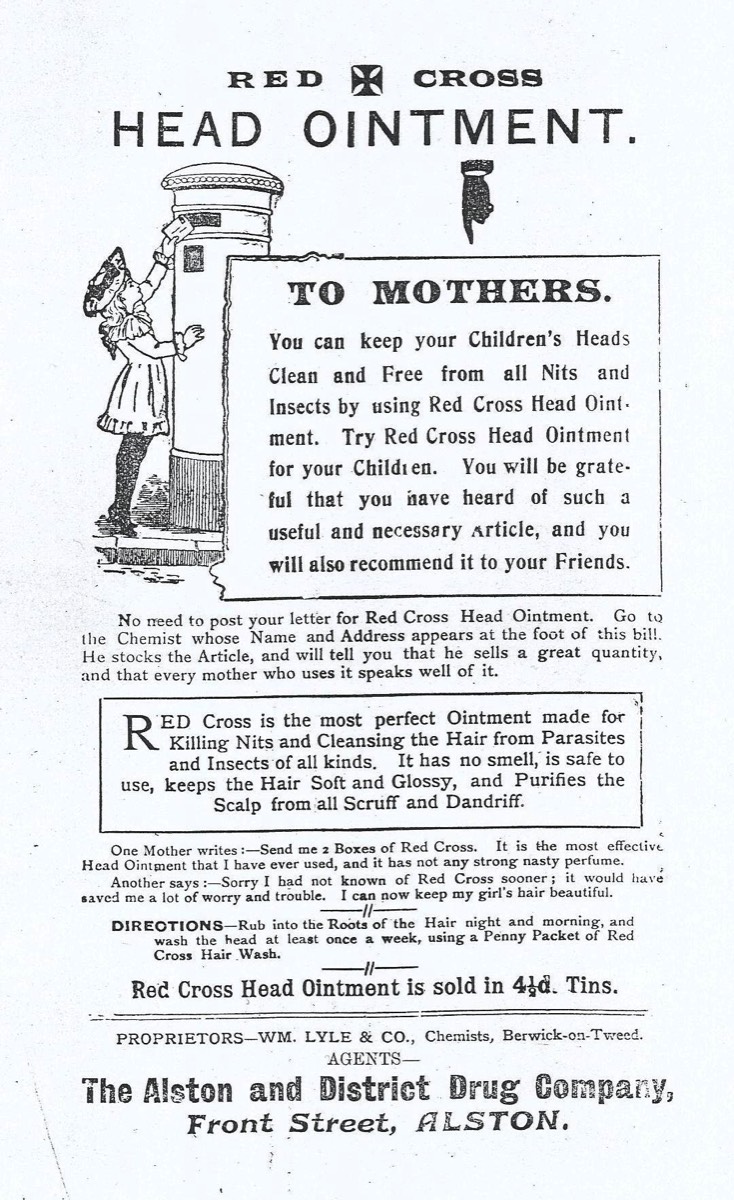
During the later stages of the recent renovations, some floorboards and skirting were removed, allowing some clues came to come to light. What the clues consisted of were; an advert for head ointment, an advert for several remedies, a calendar for 1904 and a couple of bottles with remnants of their labels. One of the labels advertised a cleaning fluid for kid and dogskin (?!) from “J. A. Roberts, Cheapest Cash Chemists, Alston and Blaydon”. The calendar advertised “Atikamina” tablets (containing “No Drug Habit Heroin”!) from “Roberts Chemist, Alston, The Alston & District Drug Co.”, while the “Red Cross Head Ointment”, “for Killing Nits and Cleansing the Hair from Parasites and Insects of all kinds”, was available from “The Alston & District Drug Company”, and “Miller’s Ruby Cough Elixir” could be bought of “Roberts, Chemist (Late Miller), Blaydon”. The calendar had the label; “Robert’s, Chemist, Alston, the Alston Drug Co.”.
These items tell the story that J. Roberts arrived on Alston Moor sometime during 1904, too late for inclusion in the trades directory for that year. For some reason he had expanded his Blaydon business, which he had acquired from Mr. Miller, perhaps in 1900, to Alston. His shop in Blaydon had been modified and he had been left with a window casement that was too attractive to be disposed of. He brought it to fit the new window opening that had replaced the first floor door of the newly acquired and renovated premises. By 1906, Mr. Roberts had abandoned his own name in the business title and called it simply ‘The Alston Drug Company’. He also left us with this little puzzle.
Above the bay window of what is now Alston Clock Shop is a smaller window with a mortar and pestle, the sign of a chemist, engraved in the glass. The design also includes the initials J.R. and the date 1900. An interesting and attractive feature, certainly, but - in 1900 there was no window, the opening was a first floor door. Also, there was no chemist in Alston with those initials. This puzzle led to some detective work to uncover the story of why and how the window came to be there.
A few years later there was a chemist’s shop in those premises, called the Alston Drug Company. However, its first appearance in a trades directory was not in that published for 1901, nor in the following directory of 1904, but in the next directory, for 1906 - six years after J.R.’s date in the glass.
During the renovations to create the present shop, from autumn 1999 to spring 2000, Peter Docherty, the owner of shop and a horologist, let me look at the window and it is quite plain to see from the inside that the engraved window, in its own casement, is an older window fitted into a newer frame.
There is an old photograph of the Market Square that shows a building on the site of the seating area outside the Fish and Chip Shop. There were stone steps up the side to a workshop over an arch that was connected to the first floor entrance of what is now the Clock Shop. Evidence points to the demolition of the arch and building soon after 1900.
The first floor doorway to the present Clock Shop was changed to a window and the ground floor shop front was flush with the front wall, as evidenced by another photo of that part of the Market Square. This situation cannot have lasted long because other early twentieth century photographs show the bay window, with the Alston Drug Company’s name quite plainly above it. But where does this leave J.R. and the mortar and pestle in 1900?
During the later stages of the recent renovations, some floorboards and skirting were removed, allowing some clues came to come to light. What the clues consisted of were; an advert for head ointment, an advert for several remedies, a calendar for 1904 and a couple of bottles with remnants of their labels. One of the labels advertised a cleaning fluid for kid and dogskin (?!) from “J. A. Roberts, Cheapest Cash Chemists, Alston and Blaydon”. The calendar advertised “Atikamina” tablets (containing “No Drug Habit Heroin”!) from “Roberts Chemist, Alston, The Alston & District Drug Co.”, while the “Red Cross Head Ointment”, “for Killing Nits and Cleansing the Hair from Parasites and Insects of all kinds”, was available from “The Alston & District Drug Company”, and “Miller’s Ruby Cough Elixir” could be bought of “Roberts, Chemist (Late Miller), Blaydon”. The calendar had the label; “Robert’s, Chemist, Alston, the Alston Drug Co.”.
These items tell the story that J. Roberts arrived on Alston Moor sometime during 1904, too late for inclusion in the trades directory for that year. For some reason he had expanded his Blaydon business, which he had acquired from Mr. Miller, perhaps in 1900, to Alston. His shop in Blaydon had been modified and he had been left with a window casement that was too attractive to be disposed of. He brought it to fit the new window opening that had replaced the first floor door of the newly acquired and renovated premises. By 1906, Mr. Roberts had abandoned his own name in the business title and called it simply ‘The Alston Drug Company’. He also left us with this little puzzle.